
Annabel Martin, Head of Land Management
As one of the driest summers on record gives way to a winter forecast to be wet and stormy, the Climate Resilient Otter Catchment (CROC) project is entering its final months. We look at what has been delivered, what it means for the farmers who host the work, and why we think flood and drought should be funded as one problem rather than two.
A summer without rain, a winter of storms?
This summer tested rivers across all of Europe. July 2026 was England’s driest on record, with just 10% of its long-term average rainfall, and by mid-August the south-west had received only 6% of its usual August rain. Devon, Cornwall and the Isles of Scilly remain in drought. Temporary use bans apply to South West Water customers across the region, Wimbleball reservoir has been classed as exceptionally low for the time of year, and on 16 September the company applied for a drought permit to reduce compensation flows (to the river). On farms, grass growth has been poor and winter forage stocks are under pressure. The Environment Agency warns that without sustained, above-average rainfall through the winter, recovery is unlikely in many areas.
That rain may well come. The Met Office says one of the strongest El Niño events on record is developing, with sea-surface temperatures in the key Niño 3.4 region of the Pacific forecast to exceed 3°C above normal – potentially the largest since the 19th century. El Niño tends to tilt the odds towards warmer, wetter and stormier conditions for the UK in late autumn and early winter. The Met Office puts the chance of a warm, wet autumn at 1.5 to 2 times higher than normal, with windier conditions becoming more likely later in the season.
Here lies the paradox. We need the rain, but how it arrives – and what the land does with it – matters enormously. After months of drought, soils are baked hard, cracked, and in places compacted. Intense autumn rain on land like this runs straight off rather than soaking in. The Otter valley knows the consequences: communities such as Ottery St Mary have a long history of flooding, and East Devon saw severe flash flooding as recently as May 2023. The first storms of a drought-breaking winter can be among the most damaging, and the water we will badly need next summer rushes out to sea at Budleigh Salterton.
Every drop that runs off the land is flood risk downstream in November and water lost for next July.
The flood risk element is the problem CROC was set up to tackle.
What CROC has delivered?
CROC is one of 40 projects funded through the Environment Agency’s £25 million Natural Flood Management programme, aiming to reduce flood risk to communities along the River Otter, as well as demonstrating the value of Natural Flood Management (NFM) as opposed to engineered solutions such as flood barriers. Westcountry Rivers Trust (WRT) has delivered the project with partners including FWAG South West and Devon Wildlife Trust, while the Universities of Exeter and Plymouth are monitoring hydrology and soils to test how well the interventions perform.
The project is due to complete by 31 March 2027 and is now in its final stages, with many significant nature-based solutions being completed this autumn. At the time of writing delivery is in full swing as restrictions and guidance relating to fish spawning and bird nesting mean that September and the early autumn are a critical time for in-river works.
The work has included:
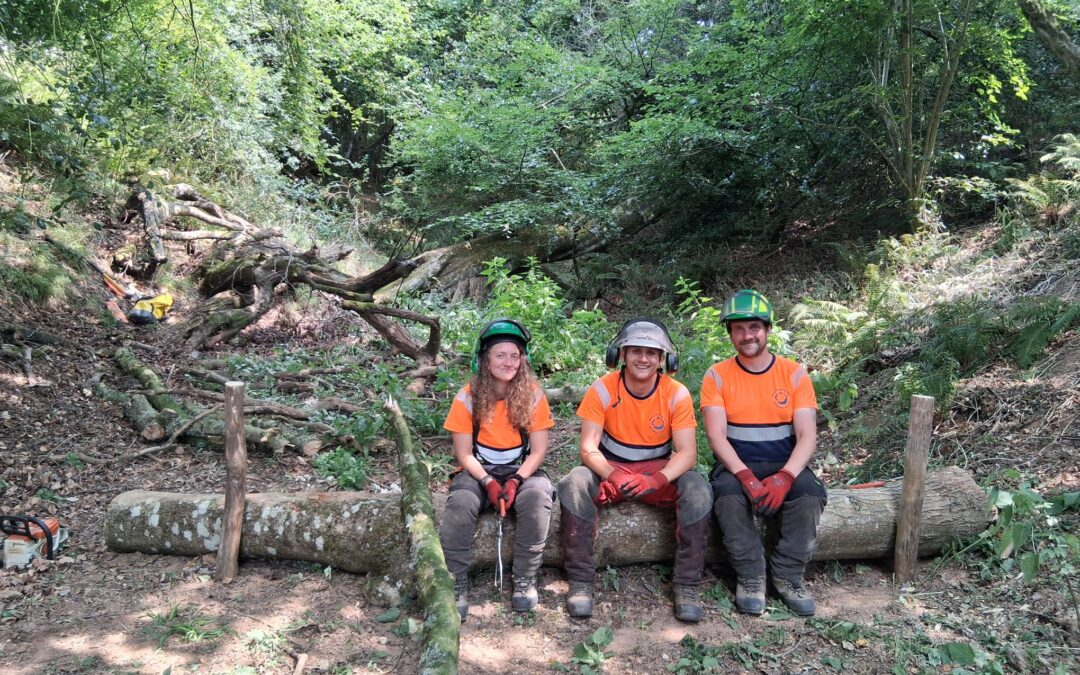
- Leaky woody dams in headwater streams and ditches, which hold back and slow peak flows during storms.
- Runoff attenuation features – bunds, scrapes and ponds that intercept water running off fields, tracks and gateways and release it slowly.
- Woodland and hedge planting to intercept rainfall and improve soil structure over time.
- Better land management, particularly soil health. CROC has not focused solely on water pathways and physical natural flood management. Farm advisers have carried out soil assessments and recommended changes to improve infiltration and percolation while reducing surface runoff, and have supported farmers with Sustainable Farming Incentive applications.
- Across the whole project, nearly a thousand interventions are planned: 621 leaky dams, 118 cross-drains (diverting water off tracks so it can infiltrate through vegetation), 37 attenuation features, plus numerous other bespoke features, as well as new woodland planting and a couple of new hedges.
The timing of in-river works, concentrated in September, is a major delivery constraint and a shortage of suitable contractors has been a further limit. Strong partnership working, and WRT’s long-term presence in the catchment, have overcome most of these challenges, and the project is making strong progress.
There is considerable pressure to deliver as much change as possible before the funding ends. Projects that have been identified but cannot be delivered within the funding period are being recorded and developed for future funding, so CROC leaves behind a pipeline for continued investment beyond March 2027.
The view from the farm gate
None of this happens without farmers. Almost every feature sits on private, working land, so how might the work look from their side of the gate?
There is a lot to like
- Soil is the farm’s most valuable asset. Water running off a field carries topsoil, nutrients and fertiliser with it – money washing down the road and ultimately into the river. Improving infiltration keeps soil and inputs where they belong.
- Better soils are drought-proofing. Soil with good structure and organic matter holds more water, so grass stays greener for longer. After a summer of poor grass growth and stretched forage, that is a very tangible benefit.
- Fewer day-to-day headaches. Flooded gateways, washed-out tracks, silted ditches and mud on the lane cost time and goodwill. Many runoff features fix exactly these problems.
- Free advice and funded capital works. Assessments, design and installation are paid for, and the advice can feed into income-generating agri-environment scheme actions.
- Being part of the solution. There is real pride in helping to protect neighbouring communities.
But there are legitimate concerns
- Land and productivity. Even a field corner matters on a tight margin, and the best places to hold water are not always the least productive.
- It goes against the grain. For generations, good farming has meant draining land and getting water off it quickly. Deliberately holding water back can feel counter-intuitive, and farmers reasonably worry about waterlogging, poaching, and machinery access.
- Maintenance and liability. Who clears a leaky dam when it blocks? What happens if a bund fails? Who is responsible after 2027? Tenant farmers may also need their landlord’s consent.
- The benefit flows downstream. The main flood benefit is felt in the village, while the farmer gives up the land and takes on the upkeep. There are few annual management payments available to farmers for re-connecting rivers with their floodplains. The vast majority of NFM features installed on farms are done so in the spirit of good will.
- Red tape. Using stored water may require abstraction or impoundment licensing, and features built with flood money can come with conditions that limit what the farmer can do with the water.
With all WRT projects we find that farmers understandably engage most readily when a feature solves a problem on their own farm as well as downstream. This is true for projects that target pollution, as well as projects that target flooding. A pond that can’t be used in a drought is a harder sell than one that also waters cattle in August. A milking dairy cow can drink well over 100 litres a day, so after this summer a secure on-farm water supply is a real business asset.
Three funders, one pond
CROC is funded through flood risk money, so its outcomes are framed around protecting communities from flooding. That shapes design; a flood attenuation feature should be empty, or nearly so, when a storm arrives, so that it can fill and then drain down slowly. A farm reservoir needs to stay full through the summer. A feature that tops up the river in a drought needs a controlled release when flows are low. Same water, same field – three different design briefs.
At the same time, WRT is working on two projects that tackle the other side of the equation:
- WaterGrid, a Horizon Europe project led by WRT with 22 partners across 13 countries, is exploring storing more water in the landscape to combat drought through “Smart Water Grids” – networks of “water batteries” such as ponds, lakes and wetlands that capture winter and storm rainfall rather than draining it away. Healthy soils and wetlands boost river base flows, and private ponds can replace mains water during peak drought.
- Water Net Gain, funded through Ofwat’s Innovation Fund (led by South West Water with WRT and partners, running to May 2027), is developing “smart ponds” that capture winter rain for use in summer. Farmers could use the water on-farm, easing demand on mains supply, or be paid to release it to recharge rivers via water companies. It is a research-phase project, however, and there is currently minimal funding to build ponds. It is more the technical and legislative aspects of the work that is being explored.
Potentially then, in the same catchment, even the same farm, we can find ourselves working on the same water under three funding types, each with its own outputs, reporting and timescale. The flood project creates attenuation features but only counts flood benefit; the water resources projects can make the case for storage but cannot yet pay to build it. A feature that could have been a dual-purpose smart pond ends up designed purely for flood attenuation, because that is what the funding recognises.
Flood resilience, farm water storage and river replenishment are not three problems. They are one: slow the water, spread it, let it sink in, and store what we can.
Getting more rain into the ground reduces peak flows in winter and feeds soils, groundwater and river base flows through the summer. A well-designed pond can keep a permanent pool for summer use with spare capacity above it to absorb a storm. The interventions are largely the same; it is the funding that divides them.
Could we achieve more?
We believe so. If funders’ objectives included infiltration and storage alongside flood risk, a single integrated project could:
- Measure what matters – cubic metres of water stored and still available in summer, hectares of soil with improved infiltration, contributions to base flow and mains water displaced, alongside properties better protected.
- Offer farmers one conversation – one design, one set of consents and one maintenance agreement, rather than several projects approaching the same holding.
- Design dual-purpose features from the outset, giving farmers a reason to host interventions that offer an income stream and a potential saving in mains water.
- Blend public, water company and private finance behind shared outcomes, so each funder gets the benefits it values from the same intervention.
This summer’s drought and this winter’s forecast are two sides of the same changing climate. Funding that treats them separately will only ever solve half the problem.
What happens next?
CROC’s final features are going in this autumn, just in time for what could be a very wet winter – a real-world test. Beyond March 2027, the pipeline of schemes CROC has identified is ready for the next round of investment. Our hope is that the next round asks a bigger question: not just how to keep floodwater away from homes, but how to keep more of that water in the Otter catchment, where farms, rivers, and biodiversity all need it. Following the Cunliffe Review, there might for the first time be a real opportunity for this kind of innovative funding to happen – with a potential joint super-regulator, a more regional approach to water planning, and more power for the catchment partnerships. If that opportunity is seized, projects such as CROC could become not just a flood scheme, but a blueprint for how communities, farmers and nature can share the benefits of water across the whole catchment.
