
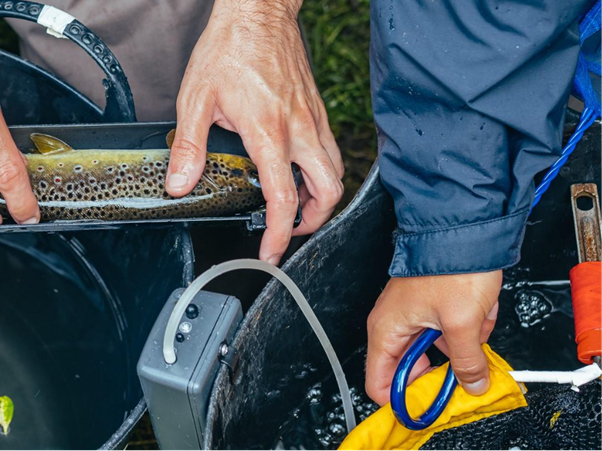
Photo Credit: Will Templeton. Fisheries officers cataloguing trout during electric fishing survey.
The Rivers and Fisheries team at Westcountry Rivers Trust (WRT) centre their work around the principle of combining a scientific approach with practical techniques to help restore the ecological health and function of rivers. Their core focus is to improving river habitat, structure, and function to ultimately protect and enhance fish species by throughout the West Country.
This approach ensures that both volunteers and professional organisations can make informed decisions that lead to meaningful improvements on the ground and contribute to a growing base of collective knowledge. WRT’s role is to gather essential data that underpins these decisions and to deliver the practical interventions required.
Positive Impacts
- DEFEND – areas with good fish stocks, habitats need defending to prevent decline
- REPAIR – areas with moderate fish stocks, habitats need assistance to recover
- ATTACK – areas with poor fish stocks, habitats need drastic interventions to improve
The team aims to monitor, protect, and enhance fish populations and habitats across the West Country. Recognising that no two rivers are the same, their focus is always on determining the most effective action to take in each unique catchment, following a Defend – Repair – Attack framework to determine level of action needed. This systematic approach relies on collecting and interpreting data to make well-informed decisions.
A major aspect of the Rivers and Fisheries team’s work is supporting the linear connectivity of rivers through the removal of barriers to fish migration. This has led to the opening of hundreds of kilometres of river to migratory fish. A key example of this is the Strategic Exe Weirs project – where we are working with The River Exe and Tributaries Association (RETA) to improve access for migratory fish throughout the River Exe catchment. In addition to linear connectivity, the team works to manage and maintain riparian (bankside) and in-river habitats to improve overall river health and functioning.
Key target species for monitoring include salmonids and eels, which serve as headline indicators for river health. Atlantic salmon are extremely sensitive to water temperature, habitat connectivity and quality, making them ideal indicators of environmental condition.
To guide their work, the team considers several key questions:
- What are the population dynamics of fish in the catchment?
- What habitat is available and is it of good quality?
- How can we improve recruitment and carrying capacity in the catchment?
- How is the river functioning?
Based on their findings, the team delivers targeted improvements, such as removing or easing migration barriers, and enhancing hydrological function and fisheries habitat. Water for Growth was a partnership project with the Environment Agency, Natural England, South West Water which brought together all these elements to remove barriers, create fish passes and improve habitats. The project delivered work in the River Camel and Fowey, you can see a summary of what the project delivered in the Camel on the information board design below.
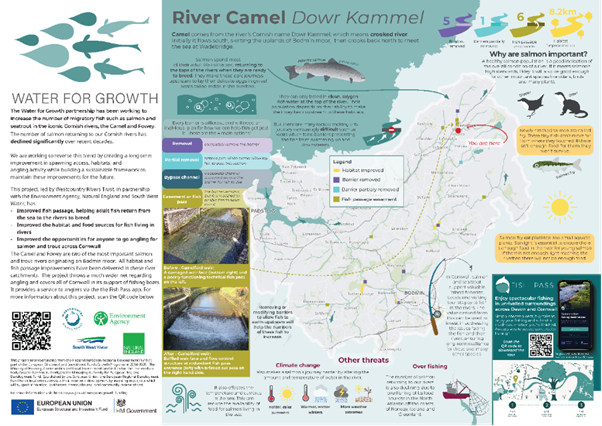
Information board summarising the work delivered in the River Camel via the Water For Growth Project which was funded by the EU Regional Development Fund.
The day to day in the Rivers and Fisheries Team
Rivers and Fisheries includes a wide variety of roles across the team, including fisheries specialists, geomorphologists, ecologists, chainsaw teams, and plant operators. This diverse skillset allows them to assess river systems, implement restoration work, and report on outcomes across the West Country.
- Fisheries and Project Officers work closely with landowners and regulators to coordinate and design vital interventions, such as weir removals, wetland creation, natural flood management and river restoration. They also carry out year-round catchment monitoring through walkovers and conduct electric fishing surveys each year to assess juvenile salmonid recruitment. This long-term dataset provides insights into spawning success and population trends, helping identify areas in need of protection or improvement.
- Operations Team members are the boots-on-the-ground workers, often found by the river with chainsaws delivering tree works to improve habitat for juvenile fish. They also plant buffer strips and wooded hillsides. In summer months, their work includes in-channel improvements like gravel augmentation and large woody debris introduction.
From Cornwall to Dorset, the Rivers and Fisheries team share a common goal: to enhance biodiversity, strengthen fish populations, and protect our rivers for the future.
Do you know what to do if you spot dead fish or fish in distress in a river?
If you see any dead fish in the river, or notice any other environmental incident, please note the precise details of the incident and report it to the Environmental Agency using their 24 hour hotline 0800 80 70 60. Examples of the incidents the Environmental Agency want to know about are given at www.gov.uk/report-an-environmental-incident.
Help us do more for our rivers
Want to get in touch?
Want more news like this?